Old Computer Challenge 2026Day 4, Wednesday |
||
Texinfo is weirdMaking some progress today writing my mini tabletop RPG. This far, this mostly involves copying and reformatting parts of the 1992 version of the FUDGE RPG, before adding my own rules and background. Given how fast this went, I don't think I'll be able to include all of it and will postpone and adventure for beyond the OCC. The good thing: It's fun enough that this means that it'll just take a few days longer. I might have to pause it a bit for another "RPG Jam" I'm participating in, but end of July seems doable. But let's talk a bit about my choice of implementation system, Texinfo. Hypertext documentationLet's start briefly with the intention of the "GNU Info system": It's meant to provide a hypertext way of documenting GNU programs (others too, but basically nobody's interested). Something man pages couldn't provide, which lead to someone at GNU (probably Stallman?) deciding that they're going for extensive info documentation instead of the well-known and industry-standard Unix man pages. As they say, this had made many people very angry and has been widely regarded as a bad move. It's not like hypertext documentation wasn't well known on other platforms, Amiga had one quite early with its "Amiga Guide", and Windows had its help files. GNU info suffered from a decent enough help browser. The info application was/is a bit lackluster. Emacs users had info as their standard documentation and thus it is well integrated, but this doesn't matter that much to the non-converted. And at a certain point in time, everyone moved to HTML for hyperlinked documentation. Windows had its ".chm" format for this, "compiled HTML pages", and doesn't even support the old ".hlp" files anymore. The Linux desktops provide what little help they offer in that format, too. 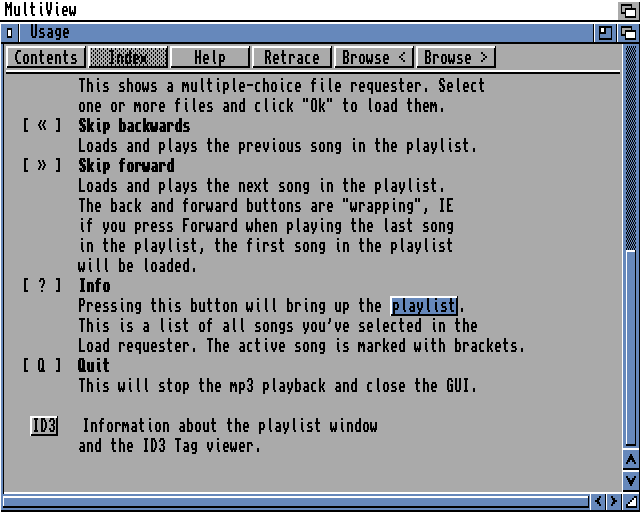
But also a floor polish!If you look at a basic Texinfo document, you notice something odd: \input texinfo @settitle Sample Document @node First Chapter @chapter First Chapter @cindex chapter, first This is the first chapter.
Texinfo uses the Neat, implementation-wise, but still a bit odd. Why go for these odd-ball at-signs in the first place? In the beginning, there was ScribeCreating printed products used to be a big thing. Hard to believe these days, right? Unix itself started out as a glorified writing system: You got an editor, tools to search text or do other preprocessing, then you sent it off to either an expensive printer, or a very expensive typesetter. One popular language (a "markup language", if you will) introduced in those early days managed to not look like line noise: Scribe.
@Heading(The Beginning)
@Begin(Quotation)
    Let's start at the very beginning, a very good place to start
@End(Quotation)
Quite understandable. And also not that unlike HTML and its predecessor SGML. But you got that at-sign there. Scribed created quite a few imitators, so before everyone went googly-eyed for lesser-than and greater-than signs, we got this.
Note: What will I actually write?Time ran away from me a bit. Today was both filled with work after being out sick for a while, and I also had to run my online RPG session. There's no way I can do that with an old computer, so I sat in front of my work Mac for most of the day. Fun was had, but not old computer fun. So it's going to be a sprint about what to put in. As I've said, I'm currently spending some time copying the relevant FUDGE rules from the original free version. The major change I'm doing there is dropping all the "ordinary words" from the rules. The game tried to get away from numbers and go for the allegedly more descriptive descriptors:
So you've got a "Good Climbing" skill, and your dice provide you with a number between -4 and +4, so you go down or up from there and get a result. Let's say you want to scale a difficult piece of mountain, so the game master requires you to get a "Great" roll. If you got a "Good" skill, that means you need to get at least a "+1" to raise your result to that level. I'm not the biggest fan of that. I never can remember whether "Fair" or "Mediocre" is worse, never mind translating that on the fly. Numbers are numbers in every language, and they're easier to work with. No "shifting up" to get a "Great" success, you just call for a "+2" result. I've grown used to people having some serious issues with even that level of math and numbers in general, but 90s Pinkdaisy wasn't that wise yet, so numbers it is. We also don't need vehicle rules or other non-fantasy mechanics, and FUDGE in general is quite a concise game. There's lots of options but that just means picking one and not writing it in my game. OCC TTRPG: The MVPingTo consider this ready for challenge release, I intend to include the following:
I might be able to do this by the end of OCC or not. The journey being the reward... But for a MVP release, something that's going to end on itch or RPG Trader, I want to add a few things more:
Coming this summer... What I did today
|
||

| ||